


Interviewer Ms. Anna Capasso comes from italy and work since Janurary for DVV Internation in Laos.
There are significant inequalities in the access to post-secondary education in Laos. In order to improve the vocational education and training system, DVV International and GIZ (Deutsch Gesellschaft fur Internationale Zusammenarbeit) are supporting the Ministry of Education and Sports in the Integrated Vocational Education and Training project (IVET), through which are offered non-formal vocational and skills trainings and courses at provincial, district and village level.
Mr. Khanthong will give us some personal insight on the project.
Mr Khanthong, can you please tell us something about yourself and when did you start working at DVV International?
I started working for DVV International in 2012, as Liaison Officer, where I am specialize in life skills and vocational education trainings. Before I was working for GIZ, where I started in 1991 and worked for twenty years. I always worked with German organizations and I also speak German.
What are your duties at DVV International?
I am a Project Manager for Skills Development and Liaison Officer; my tasks are mainly the coordination between national and district level, so I am the contact person when there is to contacting, coordinate projects, meetings and events between the government and local organizations. I am DVV International representative at national and international meetings. Alongside these tasks, I am Project manager of the Technical and Vocational Education and Training project (TVET).
What events have you been following lately?
As project manager of the TVET Project, or Mobile Skills as we call it at DVV International, I am continuously in contact with the Department of Technical Vocational Education (DVET) of the Ministry of Education and Sports. Last January 2017 we organized the Sharing and Learning workshop on Non-Formal Vocational Training Courses. During the meeting we exchanged experiences and methods used; discussed on the lessons learns and what to improve in the future, from ensuring the participation of women group and trainings for trainers and administrative officers. Beside the TVET project, I am supporting the CLC (Community Learning Centres) project when it comes to organizing trainings on life skills and keeping contact with the National University of Laos (NUOL). In fact, at the moment we are working with NUOL for integrating Life Long Learning into teacher training curricula. Last February I also attended the annual German Language Competition hosted by the German Faculty at the NUOL.
Can you give us some feedback about the TVET project?
The concept behind the TVET project was developed in consultation with GIZ, DVET and DVV International in 2010. The idea was to use the available infrastructure of formal IVET School at provincial level also for non-formal IVET courses. NFE courses were first implemented in Ban Sam Sang, as pilot model; villages and training topics were selected in close cooperation with Provincial Education and Sports Services
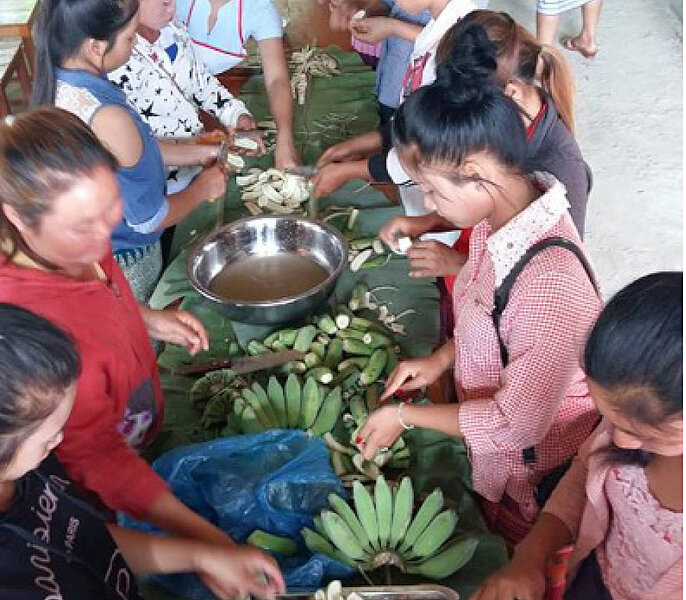
(PESS) and District Education and Sports Bureaus (DESB). The IVET School offers a various number of Trainings, such as Electrical installation, construction, mushroom cultivation, food processing, motorcycle repair and frog and chicken raising. Activities are selected from the Village Development Committee and run usually from June throughout October. The analysis of past data (participants were interviewed in 2015) showed a good feedback and possibilities of future development through higher investments. However, a careful tracer study is needed. The project needs a lot of resource and there is a lack of funding from the government. That‘s why DVV International has contributed in this field. The trainings offered are useful and valuable for the life of the villages.
How do you see your project is developed?
Right now I think that the project is still needed, because the demand is still very high. As I mentioned earlier, there is a need of a tracer study, that‘s why between April and July 2017 DVV International is planning a Tracer Study on Mobile Skills, to gather quantitative data on the project. Of course, more cooperation and support from the government is one of our expected achievements, with both DNFE and Ministry of Labor, as well as more funding for the implementation of the project itself. The Tracer Study will be the key for reaching these objectives.
Anna Capass: Thank you very much for your time. All the best with your projects.